|
|
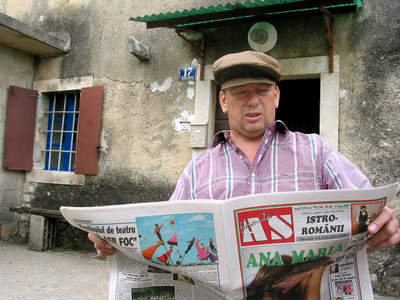
Pepo: I understand
well contemporary Romanian. Look, last week I
received a magazine from
Bucharest, and I
understand 90 percent of the text. |
Pictures from
the neighborhood - gossip with few words
“Cire bire” or hold tight
It is
believed that at the docks in the Rijeka’s harbor worked
also the Istro-Romanians who, during loading, tossing bags, to
each other yelled “Cire bire”, what in their language means
“hold on” or “hold tight”. And so the Fiumani started calling
them Ciribiri, concludes our host Pepo
Interview and pictures by Radenko Vadanjel.
Josip Glavina,
known as Pepo, is a 50-year retired coalminer from a small
Istrian town of
Susnjevica, located at the foothills of the mountain
massif called Cicarija, where by some miracle of nature grow
also olive trees. In the last ten years, Pepo, in his humble
household, has been visited by a lot of famous people: Mihai
Dorin, Romanian Demo-Christian member of Parliament,
Alexandru Costa, minister for Romanian National Minorities
outside Romania, Dr. Goran Filipi, professor at
the University of Pula “Juraj Dobrila”, Romanian scientist
[a linguistics professor and researcher] Petru
Neiescu, Romanian poet Marius Luputia, representatives of
Romanian TV from Temisvara, Bucharest, Zagreb, ….
Although very popular in scientific circles, Pepo prefers to
be with his “paesani” Bruno Kontus, retired from the
railroad, and Josip Mikleus, unemployed ex-coalminer from
Susnjevica. All three are expert speakers of the old Vlaski
language, so called "Ciribiri" or more officially
Istro-Romanian language – an unusual Romanian dialect
strongly influenced by the Croatian and Italian languages,
which has been preserved for several centuries in the
villages on the north edge of the Cepic field.
Grocery store “Susnjevica” is the epicenter of
social events
Pepo and his friends met us in
front of the grocery store “Susnjevica”, in the center of
town, where during hot summer days, in the shade of the
overhang, they drink cold beer.
“You can say that
this is Ciribiri dialect, also can be called Vlaski, but
people in Zejane call it Zejanski language. To be
correct we should say "Istro-Romanian”, explains Pepo the
various names for his native language.
|
|
|
|
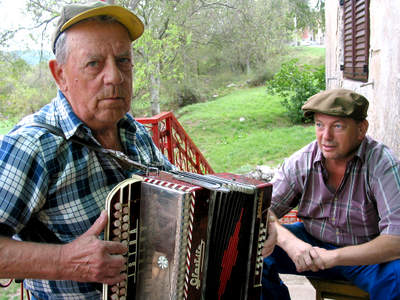
Barba Miro, even though
in his eighties and deaf on the right ear, plays the
Triestina [accordion] excellently. |
|
 |
|
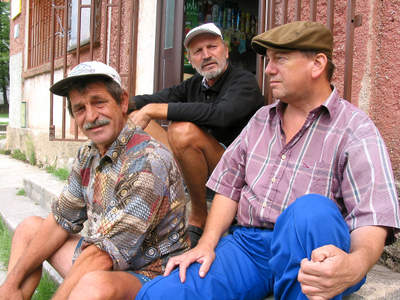
Kontus, Mikleus, and
Glavina, experts in Vlaski language. |
“Cire bire” in
Istro-Romanian means “hold tight” or “hold on”, we found out
from our host. It is believed that in the Rijeka
harbor during the loading and unloading of ship’s cargo also
worked Istro-Romanians, who, tossing the bags to each other
yelled “cire bire”, which in translation means “hold tight”.
And so in Rijeka the word "Ciribiri" became
synonymous with Istro-Romanians, concludes Pepo.
“Susnjevica is a village ignored by the county of Krsan,
which did not do even close to what they promised us. There
are more people who speak Istro-Romanian in Australia,
Canada and America than in Susnjevica”,
complains Kontus.
While Kontus and
Mikleus slowly drank their refreshments in front of the
grocery store “Susnjevica”, the epicenter of the social
events in town, we went to Pepo’s other favorite friend Miro
Belulovic [of the "Fabro" branch,
younger brother of Frane, the oft-quoted blacksmith who
passed away a few years ago]. Miro, even though, deaf
in his right ear which he damaged with the noise in the
blacksmith shop in Koromacno, plays his accordion
excellently.
“This is first
“triestina” made in 1978 between Brsec and Moscenica”,
explains barba Miro. “Pepo is like our ambassador, When we
receive scientists to study our language, they first come to
see Pepo”, explains barba Miro.
At home Vlaski, in church
Croatian, in school Italian
We found out from
our host that the big “Istro-Romanian
Linguistic Atlas” issued in 2002 by Goran Filipi, was
aided by the people of Zejane and villagers south of Ucka as
well as a dozen Isto-Romanians from Susnjevica.
“I understand very
well contemporary Romanian. Last week I received the
magazine AS from Bucharest, and I understood
about 90% of it”, said Pepo nodding with significance. “At
one time our elderly, like barba Miro, spoke Vlaski at home,
Croatian in church and Italian in school. We were polyglots
as children”, concludes enthusiastically Pepo.
“Do you know where
you originally came from”, we asked the host.
“I spent a lot of
time with the researchers from Romania
and with our Academy of Science and Art people.
Josip Milicevic was always trying to dispute the fact that
we came from Romania, instead he claims that we came from
Dalmatia and even from Bosnia, but Romanian linguists claim
that we came from the Vlachia Valley”
[this is not so], said Pepo.
Romanian language is based on four dialects and Istro-Romanian
is very close to one of these
[dacoromanian, the official language of the country].
That is why there is a great interest by Romanian linguists
to visit the villages around Cepic valley looking for some
words that have already disappeared in current Romanian
language.
Unforgettable Anastasia
“One time I was
with Anastasia Kinski in Boljun Polje”, said Pepo without
being prompted, shifting to his second big obsession –
acting in films. “She came in a stage coach and I was
supposed to split wood nearby. The movie depicted the
seventeenth century. So she got off her stage coach and
walked to a make shift bar. I looked at her, but I was not
supposed to, so the scene had to be repeated. I had to look
at her, my eyes moved in her direction automatically,
reminiscing shooting of the film “La femme musketeer” which
was made in co-production between Jadran Film and Silvester
from Los Angeles
in 2002 in Istria.”
“We also had some
love scenes in the castle Belaj from 8:00 A.M.
till noon”, remembered sentimentally Pepo.
“Well that was
beautiful. They brought girls from the Tourist Faculty of
Opatija. Five of them were acting as waitresses and five
were supposed to act as prostitutes. What should we do now?
You have to make love, said the director. They placed one of
them in my lap and said – make out! And we kissed and held
each other. We were repeating these scenes for four hours.
Four cameras were recording our scenes simultaneously”,
sighs Pepo, while Miro, a bit ignored, started playing the
triestina again.
“The girl was
collecting flowers and she fell asleep” … sang our hosts.
“Pozdraves ve si veric ne opet!” (We greet you and please come
again), at our request Pepo said it in Istro-Romanian.
The influence of the Croatian language, in this sentence is
obvious. [In fact, the quoted
statement is far more Croatian than Istro-Romanian!]
“Even we
understand this” we commented disappointedly.
“Tot aj bire”
(Everything is OK), Pepo said with a serious tone.
Translation by
Pino Golja
© istrianet.org
Source:
-
https://www.glasistre.hr/?a6f05181ca8d8ddbcc77dfb3e8f8a230,TS,2689,,14850,19515,187941,0
|